
Members Handbook
Introduction
Group rides are a great way to push yourself to ride further and faster than you might alone, while enjoying the social aspect and improving your cycling knowledge and skills. When riding in a group with the club, you are representing the club, and your actions will reflect on all its members.
When taking part in a group ride the most important consideration is Safety.
- Your own safety
- Safety of other riders in your group
- Safety of other road users you may encounter
Everyone has a shared responsibility for safety.
Rules
Rides to be led by a Ride Leader
All rides will be led by a Ride Leader who has been trained to the required standard and accredited by the club as a Ride Leader. Please speak to one of the committee if you would like to be trained.
Joining a ride
All riders should indicate their intention to join a ride by signing up on the Team app. Maximum ride group size is 10. To ensure that this is the case, you cannot join a ride group en-route unless agreed with the Ride Leader beforehand. Members should arrive at least 15 minutes before the scheduled departure time. The Ride Leader’s briefing will take place at the start and any group riding points/issues will be raised approximately 10 minutes before departure. Sub-groups will depart when they are full rather than necessarily wait for the official start time.
Support your Ride Leader
Listen for and obey your Ride Leader’s instructions. If the route has been posted on Team App beforehand, download it and familiarise yourself with it. Wherever possible the Ride Leader will appoint a “sweeper” who will assist with marshalling the group and ride discipline during the ride. Generally, the Ride Leader will ride at the front of the group and control the pace other than on hills and when it is safe for the group to share the work on the front.
Formation
We ride 2×2 unless the width of the road or other road conditions dictate single file; the Ride Leader will usually call this, but all riders should feel free to suggest this to the Ride leader should they think the situation demands it. Remember that depending on their position in the group, the Ride Leader can’t always see what other riders can see.
When riding single file, the group should split in half with a gap of about 50 yards/meters between the two groups to allow vehicles to pull in between the group if required.
Do not ride in the middle of the road – try to keep close to the rider next to you.
A good rule of thumb is to keep about a handlebar width from the rider next to you.
Do not overlap wheels with the person in front of you but follow as close as you are comfortable.
Do not allow gaps to appear in the group – if the pace is too high, speak up and let people know.
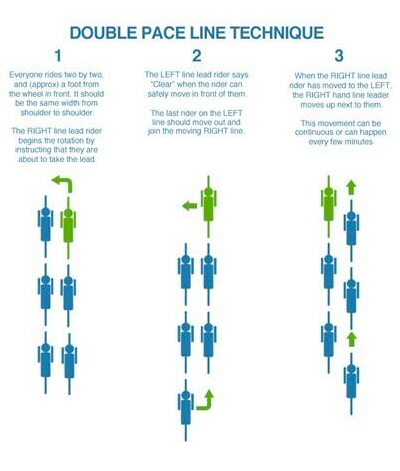
Double Pace Line (may be used by Ride Leader)
Take turns on the front – we use the Double Pace Line technique, which is explained below. The Ride Leader may call for people to change but the people working on the front may choose to do so as well. When at the front, simply keep your handlebars level with your partner – do not race each other. Keeping your handlebars level with the person next to you is a very important part of good ride discipline.
Ride Considerately
We ride together on the flatter sections and if it becomes necessary re-group by stopping (in a safe place without causing an obstruction in the road) or riding easy at the top of hills, depending on your group. If riding at the front please look behind you regularly and adjust pace to keep the group together, especially on the flat. When on the front your job is to make it easier for those riding behind, not to show everyone how strong you are. Talk to each other – tell riders at the front if the group splits or they need to ease back. Stop or pedal easily at junctions and the top of climbs to re-group.
Mudguards
Mudguards will be compulsory on club rides between 1 October and 31 March, as a consideration to other riders in the group. Ideally, front mudguards will also be fitted, but exceptions can be made when there is overlap between the mudguard and front of the shoe on shorter wheelbase bikes. The rear mudguard should extend behind the wheel to a position at least level with the bottom bracket height.
Your assistance in complying with this policy for the benefit of your fellow clubmates will be much appreciated. It is also club policy to insist on a rear-facing light throughout the year.
Half Wheeling
Lead riders should avoid “Half-Wheeling”. This is the tendency (a compulsion with some) to always keep a little ahead of the other rider. Learn to be companionable rather than competitive
Indicate Hazards
Indicate or call-out road hazards and junctions but not every minor road surface imperfection. Only call out significant hazards such as big holes – too much shouting makes people nervous, and they can over-react. Save the audible warnings for when it really matters.
Be Responsible
Take personal responsibility. Be aware of what is going on around you, behind you and ahead. Don’t blindly follow at road junctions, roundabouts or around sharp bends.
Be Supportive
Support/encourage those who are having an “off” day or are struggling. Remember, we have a no drop policy.
Produced by Thame Cycling Club 2025